6 min read
Building a Portfolio That Converts: An Engineer's Guide
How I architected zergcore.dev for recruiter-first UX.
Next.jsCareerUX
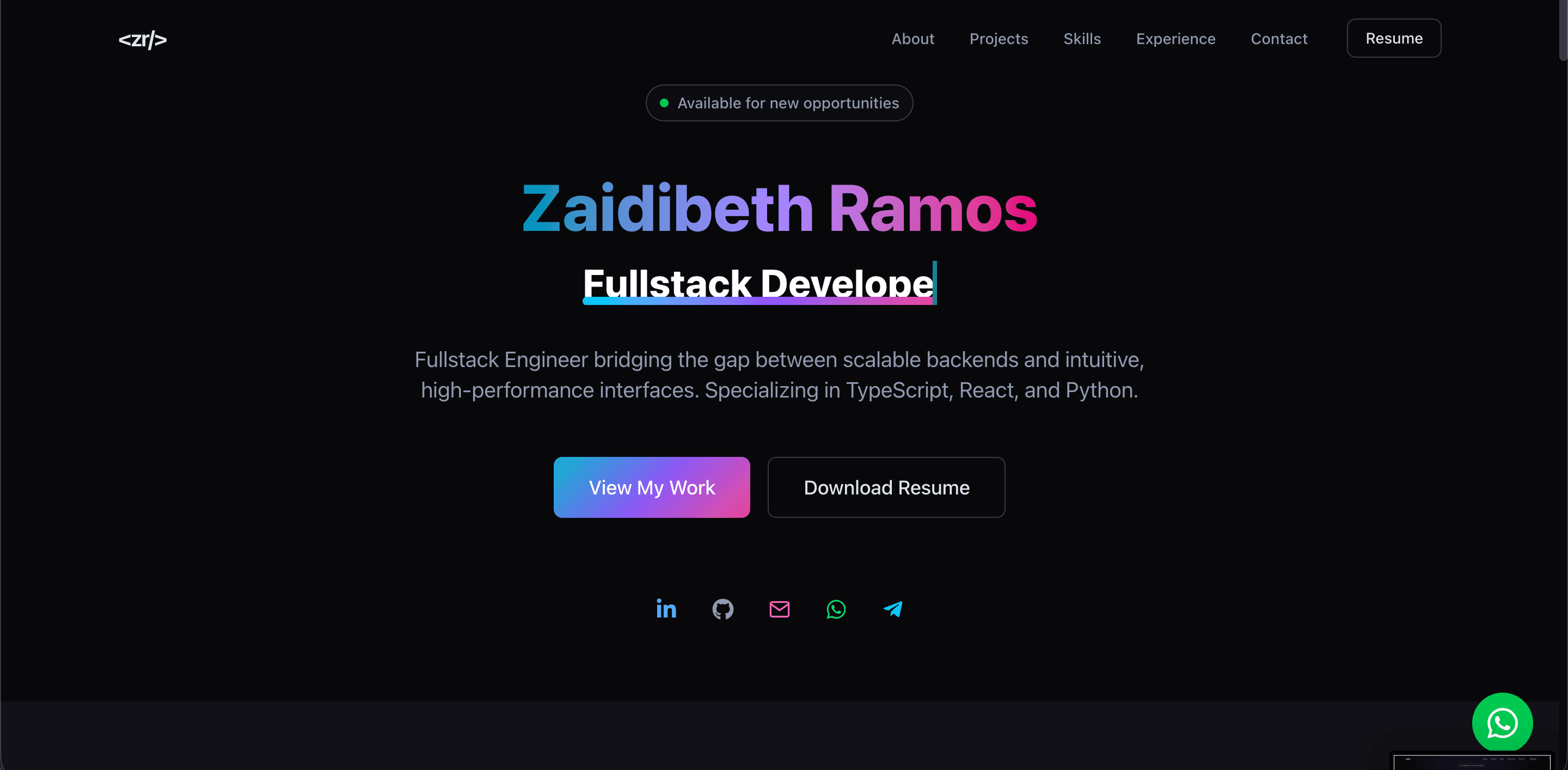
Fullstack Engineer bridging the gap between scalable backends and intuitive, high-performance interfaces. Specializing in TypeScript, React, and Python.

Full-Stack AI Engineer
As a Full-stack Engineer, my main role consists of acting as the bridge between the development of scalable backends and the creation of high-performance intuitive interfaces. I specialize in using TypeScript, React, and Python to build robust digital solutions that meet current technological demands. This comprehensive approach allows me to align data architecture with user experience, ensuring that each component within the stack operates smoothly and with maximum technical efficiency.
I'm open to new opportunities. Let's discuss how I can bring this level of engineering to your team.
Let's TalkSkip the back-and-forth. Book a slot directly on my calendar and let's discuss your project or opportunity.
Book a CallTechnical writing on architecture decisions, performance optimization, and engineering career growth.
How I architected zergcore.dev for recruiter-first UX.
A deep dive into the currency math engine behind FinApp.
A comprehensive overview of my technical stack and expertise acquired over 6+ years of professional development.
My career journey, highlighting roles where I led architecture, optimized performance, and shipped scalable products.
Revelo
Optimized the performance of Anthropic Claude 4.5 (Sonnet & Opus) and 4.6 by generating and curating high-quality RLHF datasets focused on production-ready code generation in Python and JavaScript. Simulated end-to-end engineering workflows, including code reviews, iterative debugging, and requirement validation, to ensure AI outputs mirrored professional developer behavior within Git environments. Enforced industry standards (atomic commits, documentation, and unit testing) during AI interactions to train models on professional engineering mindsets. Conducted comparative analysis (A/B testing) of model-generated solutions, evaluating code efficiency, security, and adherence to "best-fix" practices. Provided structured feedback loops (RLHF) to refine the model's ability to interpret ambiguous error reports and provide actionable, production-ready patches. Transformed AI-generated prototypes into production-grade SPAs, emphasizing modularity, clean code principles, and responsive design using HTML, CSS, and Javascript Vanilla
World of Women
Engineered Intelligent Automation Architectures: Designed and deployed scalable n8n workflows integrated with Generative AI (LLMs), automating community moderation and onboarding for users via Telegram and Discord. Developed High-Performance Frontend Modules: Built and optimized Wowland gamification components using React.js, Next.js, and TypeScript, enhancing user interactivity and platform retention. Orchestrated Data & Backend Integrity: Managed complex data pipelines and API integrations (Drip, X Spaces) utilizing Supabase and PostgreSQL, ensuring real-time data accuracy for stakeholder reporting. Fortified System Reliability: Established rigorous QA environments, error logging protocols, and Hotjar analytics loops, reducing production deployment errors by 30% and streamlining developer-to-community workflows.
Auto Parts ID
Acted as the sole founding developer, spearheading technical R&D, AI architecture, and the initial full-stack development of complex B2B automotive platforms. Key Responsibilities: Technical R&D & Core Architecture: Led the technical design and architectural research for a scalable headless e-commerce infrastructure, prototyping and stress-testing Medusa.js V2, Next.js, and Supabase to evaluate cost-to-performance ratios. Complex Data Engineering: Engineered robust data processing pipelines using Python and TypeScript to ingest, map, and real-time cross-reference massive global automotive datasets (TecDoc and ACES/PIES). AI Backend Development: Architected the data flow for Heyleo, a generative AI copilot for diagnostics and quoting, integrating advanced vectorization via AstraDB and Langflow. External API Integrations: Designed seamless, robust external APIs to connect the AI copilot and core database logic with multiple external e-commerce platforms, including Shopify and BigCommerce.
OttoMoto LLC
Launched OTTOpolicy™: integrated MeasureOne for automated insurance verification and policy updates; improved dealer conversion and operational efficiency.
Delivered Add Vehicle flow with secure auth, input validation, error handling, and end-to-end platform integration.
Established a robust test suite (Jest, Vitest, Nock, Cypress) raising coverage and shrinking critical defects.
Fundación AmbLeMa
Engineered backend integrations and database redesigns utilizing TypeScript and Python (Flask).
Optimized Dockerized deployments to cut average API latency by 300ms and achieve 99.9%+ system uptime.
Dame Un Bite
Design and develop high-quality software solutions for White Logistics, a web application for delivery B2B, using React.js, Next.js, Redux, Node.js, Tailwind, HTML, and Git. Develop APIs to be implemented in production. Implement new features and maintained the existing code. Refactor the existing code, fixing issues Main achievements: Implemented the whole lifecycle of White Logistics natively Successfully integrated Google Maps Autocomplete web service Added Stripe to set up future payments Used Next-auth and Auth0 for role-based SSO Login
Zero365
Develop and maintain Zero365 web page Develop new web pages using HTML, CSS, Bootstrap, Javascript, and React Automatized processes and develop bots and workflows as solutions to collect and deliver information about the company, and give real-time answers. This was made using Python, Node.js and Pipedream Main achievements: Developed a bot to collect the messages sent by the company employees in private and public groups we were working in, and produced metrics so we could evaluate if the goals were being made. The result was that we tripled the onboarding clients
Zero365
Directed content strategy and team operations, focusing on quality assurance, team engagement, and cross-functional alignment. Key Responsibilities: Team Leadership & Mentorship: Managed and motivated a dedicated content team, fostering a collaborative environment with high participation and engagement rates. Quality Assurance & Feedback: Conducted regular content evaluations, providing structured, actionable feedback to maintain high-quality output and align with company standards. Operational Management: Acted as the primary point of contact for team concerns, proactively identifying blockers and implementing solutions to streamline workflows. Stakeholder Reporting: Tracked team performance metrics and delivered comprehensive strategic updates to senior leadership to guide departmental goals.
Zero365
Spearheaded algorithmic growth and community engagement strategies for emerging tech projects, leveraging organic discourse to drive brand visibility across major social platforms. Key Responsibilities: Technical Research & Strategy: Conducted comprehensive deep-dives into client projects to distill complex technical concepts into highly engaging, platform-specific marketing narratives. Algorithmic Optimization: Leveraged sentiment-driven content strategies—including devil’s advocate positioning and debate generation—to optimize social algorithms (Twitter, Reddit, Telegram) and maximize organic reach. Community Engineering: Sparked and moderated high-impact community discussions that generated viral hype, successfully capturing investor attention and driving user acquisition. Ecosystem Growth & Viral Campaigns: Directed algorithmic growth and sentiment campaigns for major Web3 ecosystems and viral dApps—notably Injective, WAVES, and STEPN—successfully translating complex protocol mechanics into explosive community engagement and user acquisition.
PUBLIANAGRAMA SL
Developed new features in different projects working with Laravel, PHP, LaravelMix, Node, Javascript, HTML, and CSS. Main achievements: Delivered the first version of the courses platform Xtromba.
Autónomo
Taught calculus, accounting, and English, among other engineering subjects. Also assistance in particular homework.
CIDE, S.A.
Training on the PHP, use of JasperReports and FPDF for report development, Developing reports using PostgreSQL as database manager.
Maia Software
Project Call Center management System (Java) Developed using Java as a programming language. Bootstrap was used as CSS/JS Framework and Jsp for managing views. PostgreSQL was used as the Database manager.
Yamaro Constructions, C.A.
Supported large-scale construction planning by executing quantitative material analysis, cost estimations, and technical drafting. Key Responsibilities: Quantitative Analysis & Budgeting: Conducted precise material take-offs (cómputos métricos) using Excel and developed comprehensive project budgets utilizing LuloWIN. Technical Documentation: Authored detailed technical specifications, project scopes, and construction planning documents to guide operational execution. Technical Drafting: Designed and modified structural and architectural blueprints using AutoCAD to support field engineering teams.
A selection of my recent work, focusing on scalable architecture, AI integrations, and high-performance interfaces.

📱 App Summary The application is named Fin and is designed as a personal finance management and expense tracking tool. According to the keywords and project setup, its core features likely include: Expense Tracking & Budgeting: Managing day-to-day transactions and financial planning. Currency Support: Specifically tailored to handle different currencies, mentioning USD, USDT, and Venezuelan Bolívares. Internationalization (i18n): The app supports multiple languages natively, using localized routing. AI Integrations: It includes AI SDK packages, suggesting features like intelligent categorization, receipt scanning, or an AI financial assistant. 🛠️ Technology Stack Core Framework & Language Next.js (v16.1): The core React framework, utilizing the modern App Router architecture (src/app). React (v19): The foundational UI library. TypeScript: Used throughout the project for static typing and better developer experience. Styling & UI Tailwind CSS (v4): For utility-first styling. Radix UI & shadcn/ui: The app relies heavily on headless, accessible Radix UI primitives (Dialogs, Popovers, Selects, etc.) which are likely styled using shadcn/ui components (indicated by the components.json file). Lucide React: For scalable vector icons. next-themes: To handle seamless dark/light mode switching. Sonner: An opinionated toast component for in-app notifications. Backend, Database & Auth Supabase: Acts as the primary backend-as-a-service. @supabase/ssr: For secure, server-side authentication and data fetching within Next.js. @supabase/auth-ui-react: Pre-built authentication interfaces. It uses local Supabase configuration and migrations (found in the supabase/ directory) to manage the database schema. Data Management & Forms React Hook Form: Used for managing complex form states. Zod: Used for robust form validation and schema definition. TanStack Table: A headless UI library used for building complex, interactive data grids/tables (likely for transaction lists). Recharts: A composable charting library built on React components, used for financial data visualization and dashboards. Utilities & Integrations next-intl: Handles the multi-language support (i18n) and localized routing. Vercel AI SDK (ai, @ai-sdk/google): Integrated for building AI-powered features, specifically connected to Google's AI models. Date Management: date-fns for manipulating dates and react-day-picker for calendar components. Vercel Analytics: Included for tracking page views and user engagement. Browser Image Compression: Used to compress images (like receipts or avatars) on the client side before uploading them to the server.

Overview: Designed and implemented a novel hierarchical computational approach to solve the "curse of dimensionality" in high-dimensional oncology genomic data. By hybridizing Ant Colony Optimization (ACO) and the Firefly algorithm, we created an advanced feature selection pipeline capable of isolating critical breast cancer biomarkers from massive genomic datasets. Architecture & Execution: Pipeline Design: Engineered a two-stage evaluation system: a statistical pre-filtering layer utilizing Mutual Information, followed by a robust Wrapper evaluation layer. Swarm Orchestration: Utilized ACO for global exploration to identify promising genetic subspaces, while deploying the Firefly algorithm for aggressive local exploitation to prune redundant features. Mathematical Regularization: Mitigated evolutionary overfitting—a common issue in microarray analysis—by mathematically bounding the search space. This was achieved through strict cardinality penalties and the integration of a heavily regularized LinearSVC evaluator. Validation: Quantitatively validated the swarm's stigmergic emergence using Shannon Entropy decay metrics. Impact & Results: Achieved massive dimensional compression, reducing the pre-filtered genome from 200 features down to an optimal subset of just 13 critical biomarkers. Delivered high predictive accuracy on an isolated test set (F1-Macro = 0.9440) for breast cancer subtype classification. Mathematically demonstrated the superiority of a hierarchical, hybridized architecture over isolated metaheuristics, prioritizing clinical viability through the Principle of Parsimony.

Arkano is a modern, AI-powered platform for Tarot and Esotericism. It acts as an interactive tool that provides users with deep, personalized tarot readings generated by artificial intelligence. Key Features: AI-Powered Readings: Uses Google Gemini to generate custom interpretations of tarot card spreads. Esoteric RAG (Retrieval-Augmented Generation): The AI's interpretations are grounded in actual esoteric PDF manuals that have been parsed and loaded into a vector database, ensuring high-quality, specialized responses. Credit & Wallet System: Users have a digital wallet to manage credits. They get daily free readings and can purchase more credits through integrations like Stripe or "Pago Móvil". Multilingual Support: Fully supports English and Spanish. Admin Dashboard: Includes an administration panel to manage users, assign funds, review support tickets, and configure global settings. Native Automations: Uses background database cron jobs (pg_cron) to handle daily resets, like giving out daily free credits. 🛠️ Technology Stack The project is built on a modern, full-stack JavaScript/TypeScript ecosystem. Core & Frontend: Framework: Next.js 16.1 (using App Router) Language: TypeScript and React 19 Styling: Tailwind CSS v4 Icons: Lucide React Internationalization (i18n): next-intl Markdown Rendering: react-markdown and remark-gfm (likely used to render the AI's rich-text responses cleanly) Backend & Infrastructure: Database, Auth & Storage: Supabase Uses Supabase Auth for session handling and role-based access control (Admin vs. User). Uses PostgreSQL (with pgvector for RAG capabilities) and pg_cron for database-level task scheduling. AI Integration: Google Gemini (@google/genai) Payments & Emails: Payments: Stripe integration Transactional Emails: Resend Analytics & Monitoring: Analytics: PostHog (posthog-js, posthog-node) and Vercel Analytics (@vercel/analytics) Utilities / Scripts: PDF Processing: pdf-parse (used in backend scripts to ingest the esoteric manuals for the RAG architecture)
This project, Zergcore, is a modern full-stack web application built for a professional portfolio and CMS platform. It features a decoupled architecture with a high-performance Python backend and a reactive TypeScript frontend, designed with a focus on AI integrations and asset management. Project Summary Zergcore serves as a digital headquarters, likely managing professional assets like resumes, portfolio projects, and AI-driven features (such as the "AI CV Architect"). The project is currently transitioning from a legacy Django system to a modern FastAPI + Next.js stack to improve performance, scalability, and developer experience. Architectural Overview 1. Backend (The "Brain") The backend is built with FastAPI, emphasizing speed and type safety. Framework: FastAPI for the REST API layer. Database & ORM: SQLAlchemy 2.0 (Asynchronous) with PostgreSQL (via asyncpg). Migrations: Alembic manages database schema versions. Security: JWT-based authentication using python-jose and bcrypt. Integrations: Cloudinary: Handles image and document (PDF) storage. Resend: Manages transactional emails. AI/PDF Tools: Uses pypdf for document processing, with hooks for LLM integrations. Legacy Path: A _legacy_django directory exists, containing the original codebase being phased out. 2. Frontend (The "Face") The frontend is a cutting-edge Next.js 15 application. Framework: Next.js (App Router) with React 19. Styling: Tailwind CSS v4 for a utility-first, modern design system. Animations: Framer Motion provides high-end micro-animations and transitions. Icons: Lucide React and React Icons. Type Safety: Strict TypeScript implementation throughout the UI and API client layers. 3. Infrastructure & Workflow Monorepo-lite: Organized into clear /backend and /frontend directories. Deployment: Docker-ready (via Dockerfile in backend) and optimized for platforms like Vercel (frontend) and traditional cloud providers. Dev Experience: Uses uvicorn with uvloop for the backend development server and Next.js Turbopack for the frontend. Directory Highlights backend/app/models/: SQLAlchemy database models. backend/app/routers/: API endpoints organized by feature. frontend/app/: Next.js App Router pages and layouts. frontend/components/: Reusable UI components. docs/: Project documentation (including historical context like btw.txt).
My academic background and continuous learning achievements.
My role centered on designing software architecture, crafting efficient algorithms, managing database systems, and delivering full‑stack web applications. I translated product requirements into modular components, defined APIs, and kept a clear separation between front‑end and back‑end layers. I optimized data schemas and query patterns to maintain low response times and support growth. Across the stack I wrote, tested, and maintained code that met quality standards and enabled rapid feature delivery.